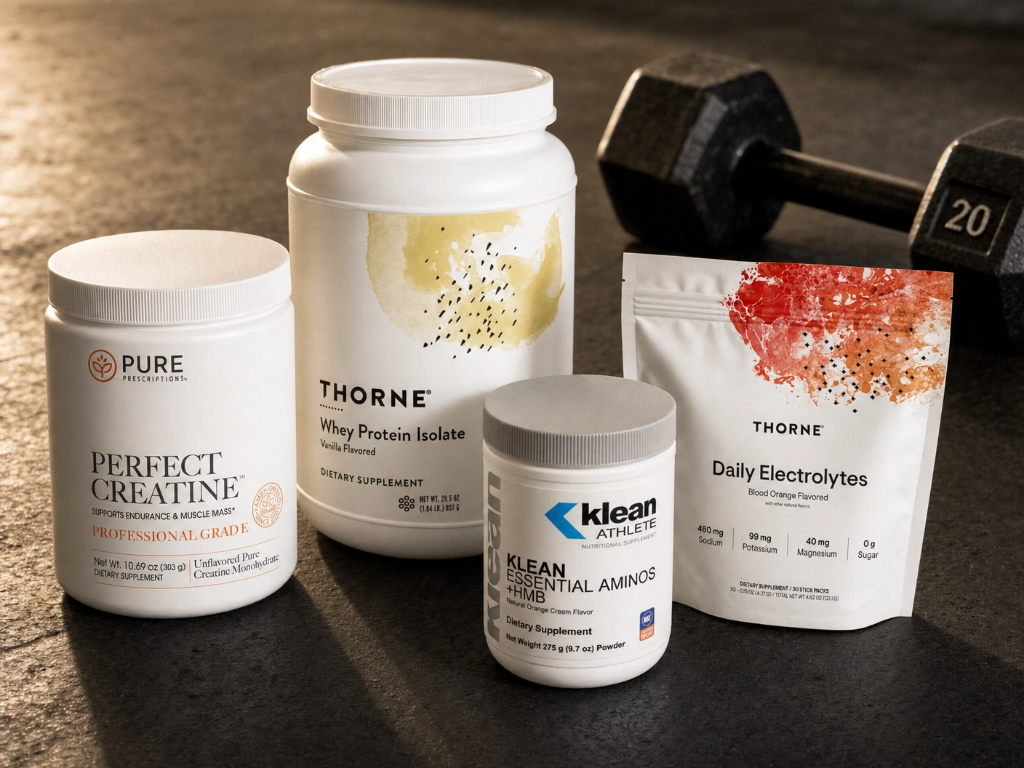
Creatine has an image problem. It’s been living in the gym bag next to the protein powder and the pre-workout for so long that most people assume it belongs to a very specific type of person. It doesn’t. The biology doesn’t care about your gym membership.
Creatine is one of the most extensively researched compounds in nutritional science. Not in sports nutrition — in all of nutritional science. We’re talking about thousands of peer-reviewed studies spanning over four decades, published in journals covering sports medicine, neurology, cardiology, endocrinology, and aging research. The evidence base is not narrow. It’s enormous. And it points in a direction most people haven’t been told about.
So let’s start over. What creatine actually is, what it actually does, who actually benefits from it, how to dose it correctly, and why the form you choose matters more than most people realize.
What Creatine Actually Is
Creatine is not a synthetic compound invented by the supplement industry. It’s a naturally occurring molecule synthesized in your body — primarily in the liver and kidneys — from three amino acids: arginine, glycine, and methionine. You also get it from dietary sources: red meat and fish contain meaningful amounts, though not enough to saturate muscle stores in most people.
Its biological function is specific and well understood. Creatine combines with phosphate to form phosphocreatine, which is stored in muscle and brain tissue. When your cells need to produce ATP rapidly — during high-intensity muscular contraction, during intense cognitive effort, during any activity that demands immediate energy — phosphocreatine donates its phosphate group to ADP to regenerate ATP. This happens faster than any other energy pathway in the body.
In practical terms: creatine is the fuel for your immediate energy reserve. The tank that empties in the first 10–15 seconds of maximal effort, and the one that determines how quickly you recover between those efforts. Supplementing creatine expands that tank. That’s the entire mechanism. It’s not a stimulant, it’s not a hormone, it’s not a drug. It’s a phosphate donor.
“Creatine doesn’t stimulate anything. It doesn’t manipulate any hormonal pathway. It expands the size of your body’s immediate energy reserve. That’s it. That’s enough.”
Who Benefits From Creatine — And It’s Not Who You Think
The bodybuilder narrative persists because creatine was first widely adopted in strength sports in the 1990s, after the 1992 Barcelona Olympics drew attention to its use by British sprinters. From there, the gym community ran with it, and the marketing followed the money. But the research went somewhere much broader.
The original application, and still well-supported.
Creatine supplementation consistently improves performance in high-intensity, short-duration exercise: sprinting, weightlifting, jumping, interval training. Average strength gains in resistance training programs run 5–15% above placebo over 4–12 weeks. The effect is largest for activities that rely on the ATP-phosphocreatine system — which covers most recreational and competitive sports.
This is where most people are surprised.
The brain is one of the most energy-intensive organs in the body and a significant consumer of phosphocreatine. Multiple clinical studies have demonstrated that creatine supplementation improves working memory, processing speed, and cognitive performance under fatigue — particularly in populations with lower baseline creatine stores (vegetarians, older adults, sleep-deprived individuals). The effect sizes are meaningful.
As we age, both muscle creatine stores and the rate of creatine synthesis decline.
Combined with the natural loss of fast-twitch muscle fiber and declining neuromuscular function, this contributes directly to sarcopenia — age-related muscle loss. Creatine supplementation in adults over 55, combined with resistance training, has been shown in multiple trials to significantly slow or reverse sarcopenia and improve functional strength. This is not a performance benefit. This is a quality-of-life benefit.
Dietary creatine comes almost exclusively from animal muscle tissue.
Vegetarians and vegans have significantly lower baseline muscle creatine stores — sometimes 20–30% lower than omnivores. As a result, they respond more strongly to supplementation and have more room to improve baseline cognitive and physical function. If you don’t eat meat, creatine supplementation is essentially non-optional.
Dosing: Loading vs. Maintenance — What the Research Says
There are two evidence-based approaches to creatine dosing, and neither is wrong. They just have different timelines.
The loading protocol saturates muscle creatine stores faster. It involves taking 20 grams per day — split into four 5-gram doses — for 5–7 days, followed by a maintenance dose of 3–5 grams daily. At the end of the loading phase, muscle creatine is fully saturated and performance benefits are available. This is the approach used in most short-term studies and is appropriate if you want results within the first two weeks.
The maintenance-only protocol skips loading entirely and uses 3–5 grams daily from the start. Muscle creatine reaches saturation after approximately 3–4 weeks of consistent dosing. The endpoint is identical — full saturation — but the timeline is longer. For most people who aren’t preparing for a specific event or competition, this is the more practical approach. No GI discomfort, no extra planning, no need to time multiple doses throughout the day.
My recommendation: 5 grams daily, every day, with any meal or liquid. Don’t overthink the timing. Post-workout has a slight edge in the literature — insulin sensitivity is elevated after training and creatine uptake into muscle tissue is enhanced — but the research on timing is much less consistent than the research on simply taking it every day. Consistency is the protocol.
“Loading gets you to saturation in a week. Maintenance gets you there in a month. The destination is identical. Choose based on your patience level, not the marketing.”
The Forms of Creatine — And Why Most of Them Are Unnecessary
Walk into any supplement store and the creatine section looks like a chemistry textbook. Creatine monohydrate, creatine HCl, buffered creatine (Kre-Alkalyn), creatine ethyl ester, creatine malate, creatine nitrate, creatine AKG. Each one marketed as an improvement on the last. Most of them aren’t.
The Gold Standard.
This is the form used in the overwhelming majority of creatine research — we’re talking thousands of studies over 40+ years. Creatine monohydrate is the compound that demonstrated improved strength. It’s the compound that improved cognitive function. It’s the compound that improved sarcopenia outcomes. Everything else is measured against it. Micronized creatine monohydrate has smaller particle size for better mixing and slightly improved absorption, but the base compound is the same. This is what we use in Perfect Creatine™.
More soluble than monohydrate, which allows for a smaller dose in liquid.
Marketed primarily on the basis of reduced GI discomfort — an issue that is largely a non-problem with micronized monohydrate at standard doses. The HCl form is more expensive, and the human research demonstrating equivalent or superior outcomes to monohydrate is limited. It’s not a bad product. It just hasn’t earned its premium price in the clinical literature.
A pH-buffered form of creatine marketed on the claim that it’s more stable in the stomach and doesn’t convert to creatinine (a waste product) before absorption.
The problem: the premise is not well-supported. Creatine monohydrate’s conversion to creatinine in the GI tract is minimal at standard doses and doesn’t meaningfully limit its effectiveness. Head-to-head studies between Kre-Alkalyn and monohydrate have found no significant performance advantages.
One of the more aggressively marketed forms from the early 2000s.
The theory was that attaching an ethyl ester group would improve cell membrane permeability and absorption. In practice, creatine ethyl ester is actually less stable than monohydrate and converts to creatinine more rapidly — the opposite of its marketing claims. A 2009 study published in the Journal of the International Society of Sports Nutrition found that creatine monohydrate significantly outperformed ethyl ester on muscle creatine content and performance measures. This form has largely fallen out of favor in research circles.
These forms combine creatine with additional compounds (nitrate, malic acid, alpha-ketoglutarate) in hopes of combining mechanisms.
The supporting research is thin. None have demonstrated superiority to monohydrate in well-controlled human trials. The additional compounds may have their own modest benefits, but they don’t improve creatine’s core mechanism. They add complexity and cost without improving the outcome.
Why We Chose Monohydrate for Perfect Creatine™ — And Nothing Else
When we formulated Perfect Creatine™, the decision was simple: use the form with the most evidence. Full stop. The research isn’t on HCl. It isn’t on Kre-Alkalyn. It isn’t on ethyl ester or nitrate or any of the other variants that appeared over the past 20 years. The research — the consistent, replicated, peer-reviewed body of research — is on creatine monohydrate.
Perfect Creatine™ uses micronized creatine monohydrate — the same base compound that has been used in the overwhelming majority of creatine research. Micronization reduces particle size, which improves dispersibility and reduces the grittiness some people experience with standard-ground creatine. It mixes completely in any liquid: water, juice, protein shakes. No clumping, no residue.
The formula is one ingredient. No flavors, no sweeteners, no proprietary blends, no amino acids that weren’t asked for, no stimulants. Five grams per scoop. Unflavored. That’s it.
We priced it at $29.97 for a 60-day supply — roughly $0.50 per day — because creatine monohydrate is not an exotic compound and we’re not charging for unnecessary additives or marketing spend. The markup on exotic creatine forms exists to justify a price point that suggests innovation. The product underneath that marketing is often indistinguishable from straightforward monohydrate.
“Every exotic creatine form is trying to improve on a compound with 40 years of successful human trials. Almost none of them do. Start with what works.”
Common Questions — Answered Directly
Does creatine cause water retention? Yes — intracellular water retention, specifically inside muscle cells. This is part of the mechanism. It’s not subcutaneous bloating. You won’t look puffier. Your muscles will hold slightly more water, which is part of why they contract more powerfully. This effect levels off after the loading or saturation phase.
Does creatine cause kidney damage? No, not in healthy individuals at standard doses. This is one of the most persistent myths in supplementation, rooted in a misunderstanding of creatinine — a creatine metabolite that’s a standard kidney function marker. Creatine supplementation increases creatinine levels slightly, which can look abnormal on a lab panel without context. Multiple long-term safety studies, including one following participants for up to five years at therapeutic doses, have found no adverse renal effects in healthy adults.
Should I cycle creatine? The research doesn’t support cycling. Creatine stores return to baseline within 4–6 weeks of stopping supplementation, and there’s no evidence of receptor downregulation or reduced efficacy with continuous use. Taking it daily, indefinitely, is what the evidence supports.
Is creatine safe for women? Yes. The mechanism is identical in both sexes. Women in research studies show the same cognitive and physical benefits. There’s no estrogen interaction, no hormonal effect, no reason for women to avoid it. The bodybuilder branding is a marketing artifact, not a physiological reality.
The Bottom Line
Creatine monohydrate is the most well-studied performance compound in nutritional science. Its benefits extend beyond the gym to cognitive function, healthy aging, and anyone — regardless of training status — who wants their brain and muscles operating at full capacity. It is inexpensive, safe, effective, and straightforward to take.
The exotic forms are expensive solutions to problems that don’t exist. Skip them. Take 5 grams of micronized creatine monohydrate every day. That’s the protocol. That’s what the research supports. That’s what we built Perfect Creatine™ around.
References
- 1.Kreider RB et al. “International Society of Sports Nutrition position stand: safety and efficacy of creatine supplementation in exercise, sport, and medicine.” Journal of the International Society of Sports Nutrition, 2017.
- 2.Avgerinos KI et al. “Effects of creatine supplementation on cognitive function of healthy individuals: a systematic review and meta-analysis of randomized controlled trials.” Nutrients, 2018.