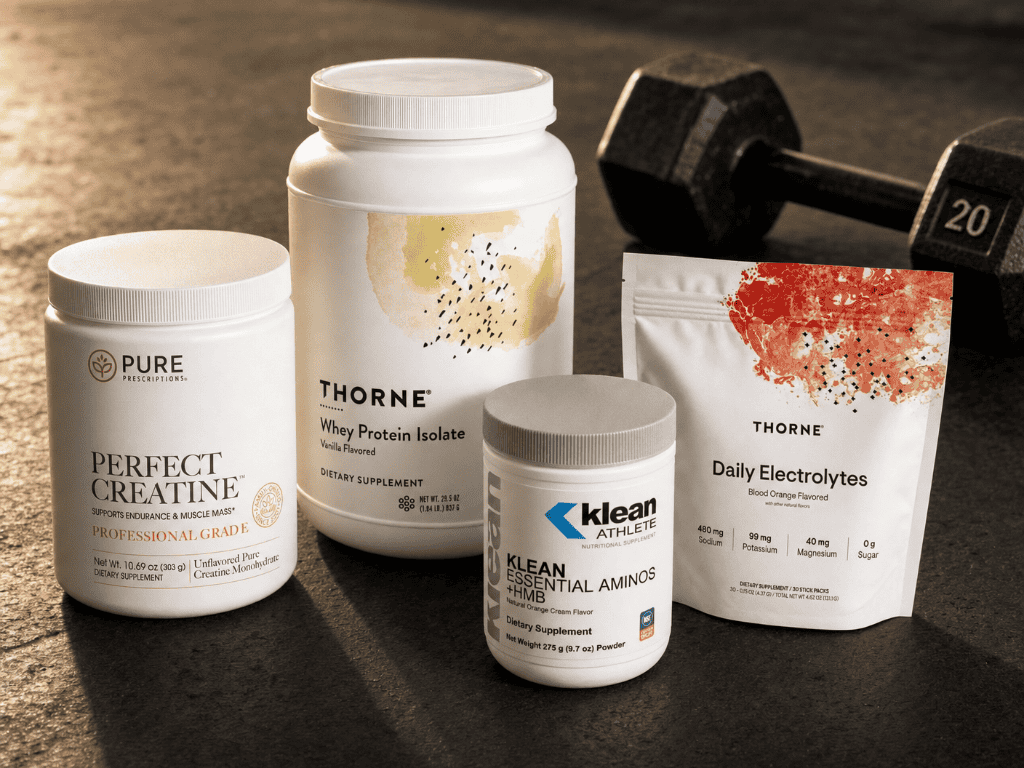
I get asked about my training stack more than almost anything else. Here it is — unfiltered.
I’ve been training seriously for over 30 years. Surfing, cycling, weight training, trail running — the modalities have shifted but the intensity hasn’t. And in that time I’ve tried nearly everything the performance supplement industry has produced. Most of it is noise. What I use today is four products. Not because I haven’t explored more — because I’ve arrived at four through elimination.
I want to walk you through each one, why it’s in the stack, and — critically — when I take it. Because with performance compounds, timing isn’t a detail. It’s the protocol.
Perfect Creatine™ — The Non-Negotiable
Creatine is the most researched performance supplement in existence. Full stop. Thousands of peer-reviewed studies. Consistent effect size. Zero meaningful risk profile at standard doses. There is no serious performance stack that doesn’t include it.
I take 5 grams of Perfect Creatine™ daily — one scoop mixed into my post-workout shake or water. The timing debate (pre vs. post workout) has been studied extensively. Post-workout has a slight edge in the literature, likely because insulin sensitivity is elevated after training and creatine uptake into muscle tissue is enhanced. On rest days I take it with a meal for the same reason. Consistency matters more than precision here — creatine works by saturating muscle stores over time, not through acute spikes.
Perfect Creatine™ is 100% micronized creatine monohydrate. No fillers, no proprietary blends, no unnecessary additions. Micronized means smaller particle size — it mixes completely in any liquid and absorbs more readily. That’s the whole formula. The research isn’t on branded forms or exotic delivery systems. It’s on monohydrate. That’s what we use.
“If you’re only going to add one thing to your training protocol, it’s creatine. The evidence is overwhelming and the cost of entry is $30.”
Whey Protein Isolate — Muscle Protein Synthesis, Done Right
Post-workout protein is one of the few performance interventions where both the mechanism and the outcome data are unambiguous. You’ve broken down muscle tissue during training. The window immediately following exercise — roughly 30 to 60 minutes — is when your muscles are primed for repair and growth. Delivering high-quality, rapidly absorbed protein in this window is not optional if your goal is performance adaptation.
I use Thorne’s Whey Protein Isolate in vanilla. The isolate form is key — it’s been microfiltration-processed to remove most of the lactose and fat, leaving behind a very high protein concentration (21g per scoop) with minimal digestive burden. It’s also NSF Certified for Sport, which matters to me from a quality-verification standpoint. Thorne adds a digestive enzyme blend — bromelain and papain — which aids breakdown and reduces the bloating some people experience with whey.
I mix it with water, not milk. Post-workout, I want rapid absorption — dairy fat slows gastric emptying. One scoop, 8–10 oz water, taken within 30 minutes of finishing training.
Klean Essential Aminos + HMB — The Anti-Catabolism Layer
This is the product most people haven’t heard of and the one I’m most emphatic about for athletes over 35. As we age, the anabolic signaling that drives muscle protein synthesis becomes blunted. We need more stimulus to achieve the same adaptation. And the window in which muscle tissue is vulnerable to breakdown — particularly during fasted training or extended sessions — widens.
Klean Essential Aminos + HMB addresses this directly. It combines a leucine-rich essential amino acid blend (Amino9®) with HMB — beta-hydroxy-beta-methylbutyrate — which is a metabolite of leucine that has been shown to directly inhibit muscle protein breakdown. It also includes Vitamin D3, which supports muscle function through its own pathway. The combination is specifically designed for muscle preservation and is backed by clinical research in aging populations and competitive athletes.
I take one scoop intra-workout or immediately pre-workout on heavy training days. On lighter days or active recovery days, I take it mid-morning with water. The goal is to maintain an anabolic environment throughout the training day — not just immediately post-workout.
Anti-catabolism compound.
A metabolite of the amino acid leucine. Shown in research to reduce muscle protein breakdown, particularly during periods of caloric restriction or high training volume. Dosed at 1.5–3g daily in most studies.
Essential amino acid blend.
All nine EAAs in a leucine-heavy ratio designed to maximally stimulate muscle protein synthesis. The leucine content (1271mg per scoop) is above the threshold required to trigger an anabolic response.
Muscle function support.
500 IU per scoop. Vitamin D receptors are present in muscle tissue, and deficiency is strongly associated with reduced muscle strength and increased injury risk. Works synergistically with the amino stack.
Daily Electrolytes Blood Orange — Hydration Is Not Optional
The electrolyte category is crowded with garbage. Sugar-heavy sports drinks, underdosed powders, proprietary blends that obscure what’s actually in them. I spent a long time looking for an electrolyte formula I actually trusted, and Thorne’s Daily Electrolytes is the one I landed on.
It delivers sodium (480mg, from Himalayan pink salt), potassium (99mg), magnesium (40mg), calcium (70mg), and chloride (750mg) — the complete electrolyte panel, not just sodium and potassium like most products. Zero sugar, zero artificial color. Blood orange flavor. One stick pack mixed into 12+ oz of water.
I take one pack about 20 minutes before training, and another immediately post-workout if the session was long or I was sweating heavily. On days when I’m training in heat or doing anything over 90 minutes, I’ll take a third mid-session. Electrolyte balance isn’t just about cramping prevention — it governs nerve transmission, muscle contraction quality, and cognitive sharpness under exertion. Dehydration of even 2% body weight measurably degrades performance. This isn’t a nice-to-have.
“Most people under-hydrate before training and over-compensate with plain water after. You need the electrolytes, not just the fluid.”
The Full Sequence
Here’s how it flows on a training day: Electrolytes 20 minutes pre-workout. Essential Aminos + HMB pre-workout or intra-workout. Immediately post-workout: whey isolate mixed with creatine in water. Done. Four products, two or three intake windows, total protocol time of about 10 minutes.
The reason I’ve held this stack constant for the past two years — and the reason I built the Athletic Performance protocol around it — is that each product has a distinct, non-overlapping role. Creatine is for ATP replenishment and strength. Whey is for muscle protein synthesis. Aminos + HMB are for anti-catabolism and preservation. Electrolytes are for hydration and neuromuscular function. No redundancy. No gaps.
That’s the stack. Take it or leave it — but if you’re training seriously and you’re not doing some version of this, you’re leaving adaptation on the table.
References
- 1.Kreider RB et al. “International Society of Sports Nutrition position stand: safety and efficacy of creatine supplementation in exercise, sport, and medicine.” Journal of the International Society of Sports Nutrition, 2017.
- 2.Avgerinos KI et al. “Effects of creatine supplementation on cognitive function of healthy individuals: a systematic review and meta-analysis of randomized controlled trials.” Nutrients, 2018.