
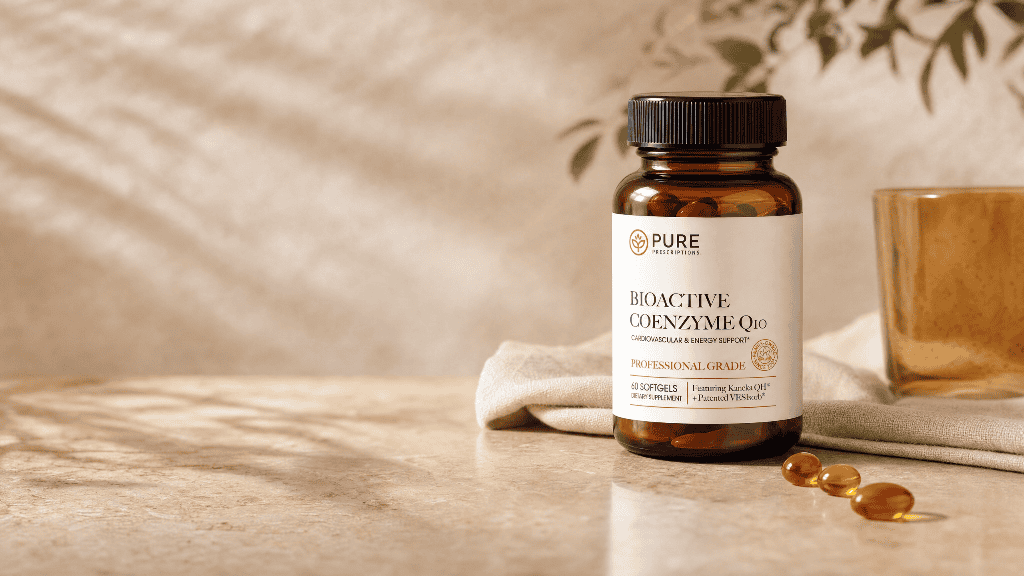
The supplement industry talks constantly about what’s in the bottle. Almost nobody talks about what actually makes it into your bloodstream.
Bioavailability — the fraction of a nutrient that reaches systemic circulation and becomes available for use by your cells — is the number the label never shows you. And for fat-soluble compounds like CoQ10, Vitamin D3, Vitamin K2, and Omega-3 fatty acids, that number varies enormously depending on how the formula is delivered. You can be taking the right ingredient at the right dose and absorbing a fraction of what you paid for.
That’s the problem VESIsorb® was designed to solve. And it’s why we use it in two of our most important formulas.
The Fat-Soluble Absorption Problem
Fat-soluble nutrients — CoQ10, vitamins A, D, E, and K, carotenoids, omega-3s — require dietary fat to be absorbed efficiently. The mechanism is straightforward: these compounds are lipophilic, meaning they dissolve in fat, not water. To cross the intestinal wall and enter the lymphatic system, they need to be incorporated into micelles — tiny fat droplets formed in the gut when dietary fat is present and bile acids are secreted.
The problem is that most people don’t consume adequate dietary fat at the moment they take their supplements. The standard advice to ‘take with food’ is imprecise. Not all food provides enough fat to optimally solubilize fat-soluble compounds. A piece of toast and coffee — common breakfast fare — provides almost none. Even a moderate meal may not produce the bile acid secretion needed for complete absorption of high-dose fat-soluble nutrients.
The result: a significant portion of what you swallow passes through the gastrointestinal tract intact, unabsorbed, and excreted. Studies on standard CoQ10 softgels have found that absorption can be as low as 2–3% of the ingested dose under fasted conditions. For a compound you’re taking precisely because your body’s natural production is declining with age, that’s a significant problem.
“Absorption of 3% is the same as taking nothing. The dose on the label is not the dose that reaches your mitochondria.”
How VESIsorb® Works
VESIsorb® is a patented colloidal delivery system developed specifically to solve the fat-soluble absorption problem. It is a self-emulsifying drug delivery system (SEDDS) — a formulation technology originally developed in pharmaceutical medicine and adapted for nutraceutical use.
Here’s the mechanism: VESIsorb® contains a precisely balanced mixture of lipids and surfactants that, when they contact the aqueous environment of the gastrointestinal tract, spontaneously self-assemble into a colloidal dispersion — a cloud of nanoscale droplets with the active compounds (CoQ10, D3, K2, or omega-3s) distributed throughout. This happens automatically, triggered by contact with gastric fluid, without requiring external mechanical emulsification.
These colloidal droplets dramatically increase the surface area of the active compounds available for absorption. Instead of large, poorly soluble aggregates sitting in the gut waiting for enough dietary fat to become available, the nutrients are already dispersed in a form the intestinal wall can absorb efficiently — regardless of whether you ate a high-fat meal or a piece of dry toast.*
The system forms its own emulsion upon contact with gastric fluid — no dietary fat required to trigger the process.
Absorption is initiated immediately and consistently, rather than being dependent on the variable fat content of whatever you happened to eat.
The resulting droplet size is in the nanometer range — small enough to integrate directly into intestinal micelles and be absorbed via lymphatic uptake.
Standard oil-based softgels produce much larger droplets with significantly less surface area available for absorption.
VESIsorb® technology has been studied in human pharmacokinetic trials.
For CoQ10 specifically, VESIsorb® delivery has demonstrated up to 6x greater absorption compared to standard oil-based softgels — a difference large enough to be clinically meaningful at equivalent label doses.
Why It Matters for CoQ10 Specifically
CoQ10 is one of the most poorly absorbed compounds in the supplement category under standard delivery. It’s a large, hydrophobic molecule — which means it resists dissolution in aqueous environments and aggregates readily in the gut. This is why absorption studies on conventional CoQ10 softgels show such wide variability: results depend heavily on the fat content of whatever was consumed nearby.
Our Bioactive CoEnzyme Q10 formula uses Kaneka QH® ubiquinol — the active, reduced form that your mitochondria can use directly without conversion — delivered via VESIsorb® technology. The combination addresses both the form problem (ubiquinol vs. ubiquinone) and the absorption problem simultaneously. You’re getting the most bioavailable form of CoQ10 that exists, delivered in a system designed to ensure it actually reaches your cells.*
In pharmacokinetic studies, VESIsorb®-delivered CoQ10 reaches peak plasma concentration faster and at significantly higher absolute levels than oil-based comparators. The difference is not marginal. It’s the kind of gap that determines whether a supplement is working or simply transiting the digestive system unimpeded.
Why It Matters for Omega-3 and Fat-Soluble Vitamins
Our Premium Omega-3 Plus uses VESIsorb® technology for the same reason — but the delivery challenge is slightly different. Omega-3 fatty acids in fish oil are themselves a lipid matrix, which helps solubilization to some degree. The advantage VESIsorb® adds here is consistency: absorption doesn’t vary based on what you ate before. More importantly, D3 and K2 — both fat-soluble and both included in our formula — benefit enormously from the colloidal environment. These are compounds where under-absorption is a widespread and underappreciated problem.
Most standalone Vitamin D3 capsules are gelatin-based and contain no fat matrix. If you take them away from food, as many people do, absorption is substantially impaired. This is one reason why studies on Vitamin D3 supplementation show such variable results — the outcome depends heavily on how consistently the supplement was taken with dietary fat, which most studies don’t control for.
“VESIsorb® doesn’t change what’s in the formula. It changes how much of it actually gets to work.”
What This Means for Your Protocol
The practical implication is simple: if you’re taking CoQ10 or Omega-3 in a standard softgel without VESIsorb® technology, there’s a real probability you’re absorbing a fraction of the labeled dose — particularly if you’re taking it on a relatively empty stomach, which is common.
With VESIsorb® delivery, you can take your CoQ10 or Omega-3 with any meal — or even with minimal food — and be confident that the absorption profile is consistent. The technology removes a major variable from the equation. What you take is what you get.*
This is the kind of formulation decision that doesn’t show up on a label in an obvious way — it’s buried in the fine print, if mentioned at all. But it represents real clinical value, especially for compounds like CoQ10 and Vitamin D3 where the therapeutic effect is dose-dependent and deficiency is widespread. Bioactive CoEnzyme Q10 and Premium Omega-3 Plus both use VESIsorb® for this reason. Not because it’s a marketing feature — because it changes whether the formula works.
The Broader Principle
VESIsorb® is the specific technology we use for fat-soluble compounds. But the broader principle it represents — that delivery format determines bioavailability as much as the ingredient itself — applies across the entire formulation landscape.
Undenatured Type II collagen requires low-temperature processing to preserve its biological activity. Magnesium glycinate requires the glycine chelate to enhance membrane transport. Curcumin requires Bioperine® to inhibit the metabolic pathway that would otherwise clear it before it reaches systemic circulation. In every case, the active ingredient is only half the story. How it’s delivered is the other half.
The next time you evaluate a supplement, look past the ingredient list. Ask how the formula was designed to get that ingredient from the capsule into the cell. That question — the delivery question — is where the real difference between a formula that works and one that just looks impressive on paper is made.