
In 1980, a Japanese biochemist named Dr. Hiroyuki Sumi was studying enzymes capable of dissolving fibrin — the protein that forms blood clots. Working at the University of Chicago, he placed a small amount of natto, a traditional Japanese fermented soybean food, directly onto a fibrin plate in a petri dish. Within 18 hours, the fibrin had dissolved in a perfect circle around the natto. He named the active enzyme nattokinase.
That was over four decades ago. Since then, nattokinase has accumulated one of the most substantial bodies of peer-reviewed cardiovascular research of any enzyme in nutritional medicine. More than 17 human clinical trials. Publications in cardiovascular journals, thrombosis research, and hypertension literature. A consistent safety record. And a mechanism that addresses several of the most important risk factors in cardiovascular disease simultaneously.
And yet most Americans have never heard of it.
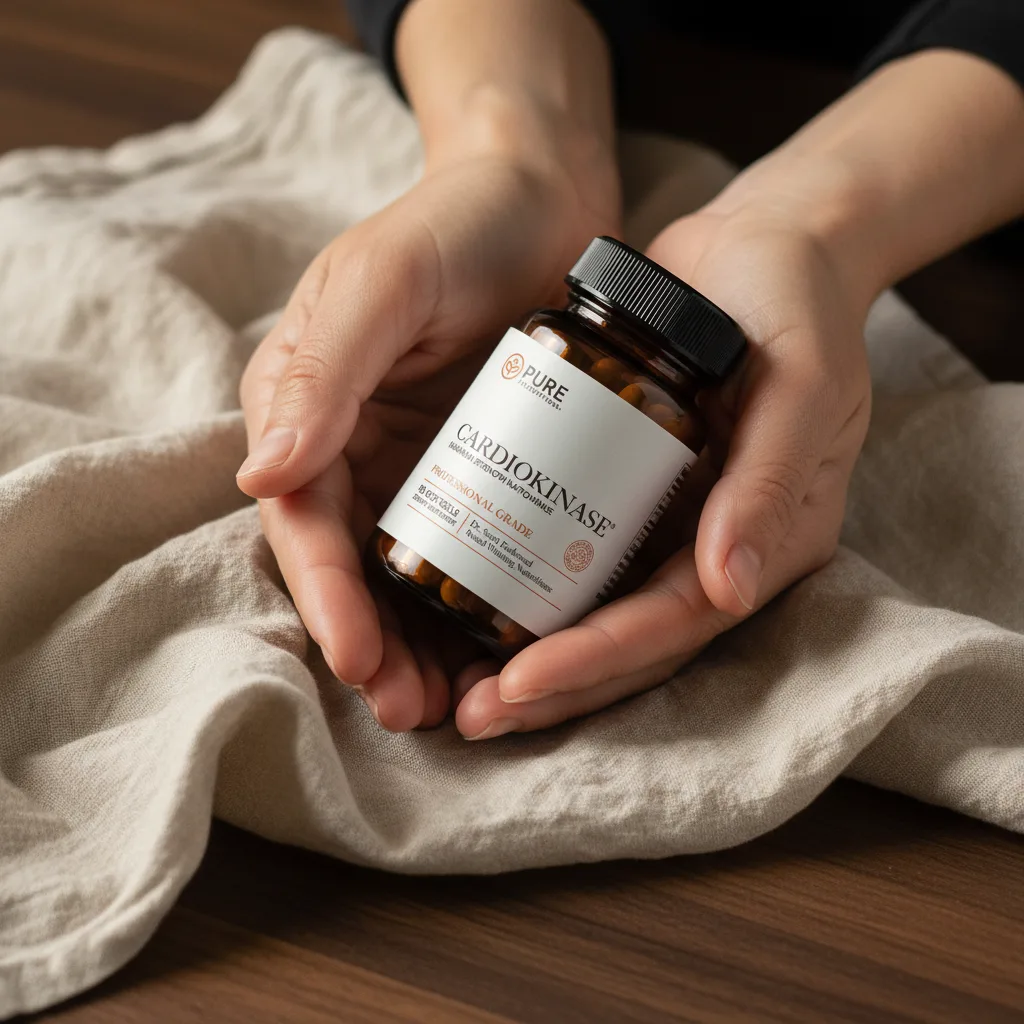
Cardiokinase™ is our professional-grade nattokinase formula — and the one I’ve personally recommended to practitioners and customers for over 20 years. Here’s the full picture: what nattokinase actually does, what the research shows, why source and quality matter enormously, and why this enzyme is having a cultural moment unlike anything I’ve seen in my career.
What Nattokinase Actually Does
Nattokinase is a serine protease — an enzyme that cleaves peptide bonds — with a specific and remarkable ability to break down fibrin. Fibrin is the structural protein that forms the mesh of a blood clot. It’s created from fibrinogen by the enzyme thrombin during the coagulation cascade, and it’s what holds a clot together once formed.
The reason this matters is that excessive fibrin deposition is a central driver of thrombotic cardiovascular events. When fibrin accumulates faster than the body’s own fibrinolytic system can clear it — as happens chronically with age, inflammation, and metabolic dysfunction — clot risk rises and microvascular circulation is impaired. Nattokinase enhances fibrinolysis: the natural process by which your body breaks down fibrin and clears clots. It does this through multiple converging mechanisms.1
Nattokinase cleaves fibrin directly — the same target as plasmin, your body’s endogenous fibrinolytic enzyme.
Unlike plasmin, however, nattokinase is relatively resistant to alpha-2-antiplasmin, the protein that inhibits plasmin in circulation. This means it continues working even in the presence of the body’s natural checks on plasmin activity.1
Nattokinase stimulates endogenous tissue plasminogen activator (tPA) — the enzyme the body uses to convert plasminogen to plasmin.
By upregulating your own fibrinolytic machinery, nattokinase supports systemic clot clearance through a second, indirect mechanism that compounds with its direct activity.
Plasminogen activator inhibitor-1 (PAI-1) is the primary endogenous inhibitor of tPA.
Elevated PAI-1 is an independent risk factor for cardiovascular events and is associated with obesity, metabolic syndrome, and inflammation. Nattokinase has been shown to reduce PAI-1 activity, further enhancing the fibrinolytic environment.
Nattokinase appears to inhibit angiotensin-converting enzyme (ACE), the enzyme that converts angiotensin I to angiotensin II — a potent vasoconstrictor.
ACE inhibition is the mechanism of a major class of pharmaceutical antihypertensives. Clinical trials have demonstrated meaningful reductions in both systolic and diastolic blood pressure with consistent nattokinase supplementation.
What the Clinical Research Shows
I want to walk through the key human studies here, because they’re more robust than most people realize.
A 2008 randomized controlled trial published in Hypertension Research followed 86 participants with pre-hypertension and stage-1 hypertension over eight weeks. The nattokinase group showed significant reductions in systolic blood pressure (−5.55 mmHg) and diastolic blood pressure (−2.84 mmHg) compared to placebo. The authors noted that the effect size was clinically meaningful — comparable to low-dose pharmaceutical intervention — with no adverse events reported.2
A 2009 Korean study published in Nutrition Research randomized 92 participants to nattokinase or placebo for two months. The nattokinase group showed significantly reduced plasma fibrinogen levels — a key independent predictor of cardiovascular events — as well as reductions in Factor VII and Factor VIII, two coagulation factors associated with thrombotic risk. Importantly, clotting time was prolonged in the nattokinase group, directly demonstrating enhanced fibrinolytic activity.
A 2017 clinical study published in the National Medical Journal of China (Zhonghua Yi Xue Za Zhi) examined nattokinase’s effects on atherosclerotic plaque over 26 weeks in patients with existing carotid artery plaques. Compared to statin monotherapy, nattokinase supplementation produced significantly greater reductions in plaque volume and carotid intima-media thickness — a clinically established surrogate marker for cardiovascular risk. This study attracted significant attention because the comparison group was receiving active pharmaceutical treatment, not placebo.
“The 2017 plaque regression data stopped a lot of people in their tracks — including me. Meaningfully greater reductions in carotid plaque volume than statins alone, over 26 weeks. That’s not a supplement talking point. That’s a trial.”
The Cultural Moment — and Why We Need to Be Careful About It
In 2022 and 2023, nattokinase entered mainstream awareness in a way I have not seen before. Search volume exploded. It became a trending topic in health and wellness communities — discussed in the context of cardiovascular health, long-COVID research, and post-vaccination considerations. I want to address this directly, because the conversation has been both interesting and, in some corners, dramatically overextended.
A 2022 paper published in the peer-reviewed journal Molecules, authored by researchers at Josai University in Japan (with collaborators at Contek Life Science in Taiwan), examined nattokinase’s ability to degrade the SARS-CoV-2 spike protein in vitro. The study used cells expressing the spike protein and incubated them with nattokinase in a lab setting — not a human clinical trial. The findings showed that nattokinase did degrade the spike protein under the experimental conditions used. The paper has been peer-reviewed and published; it is a real study by credentialed researchers.
What that study does not show — and what has been widely misrepresented in non-scientific circles — is that nattokinase supplementation produces measurable degradation of spike protein in living humans, or that it treats or prevents any condition related to SARS-CoV-2 exposure or vaccination. In vitro findings frequently do not translate to clinical outcomes. The enzyme concentrations achieved in a petri dish are not the same as what circulates systemically after oral supplementation. The mechanism is theoretically plausible, but ‘theoretically plausible’ and ‘clinically proven’ are not the same thing.
I mention this because I think intellectual honesty matters more than a trending headline. The research on nattokinase’s cardiovascular mechanisms — fibrinolysis, blood pressure, plaque regression — is robust, replicated, and clinically meaningful. That is the evidence base this product stands on. Any additional discussion of spike protein degradation should be framed as preliminary in vitro research requiring human confirmation, not as established clinical fact.
Why the Source Is Everything — and Why Cardiokinase™ Is Different
Not all nattokinase is the same. This is one of the most important things I can tell you about this category.
Nattokinase is produced during the fermentation of soybeans with Bacillus subtilis var. natto — the same traditional process used to make natto for centuries in Japan. The quality of the enzyme depends on the strain of bacteria, the fermentation conditions, the substrate quality, and most critically — how the enzyme is extracted, purified, and standardized.
The standard unit of measurement for nattokinase activity is the Fibrinolytic Unit (FU). This measures the enzyme’s actual enzymatic activity — its ability to cleave fibrin — not just its weight. A product listing ‘100mg nattokinase’ without an FU specification tells you almost nothing about potency. Two products could both claim 100mg and have tenfold differences in actual activity depending on source and processing.
Cardiokinase™ delivers 2,500 FU per softgel — above the 2,000 FU dose used in most of the clinical research. The nattokinase we use is produced through a controlled fermentation process with verified activity at harvest, independently third-party tested for fibrinolytic potency, and free from vitamin K2 — a consideration that matters clinically, as traditional natto contains significant K2 that can interact with anticoagulant medications.
“Nattokinase measured only in milligrams is like measuring coffee in ounces without specifying the roast. The number is real; what it tells you is incomplete.”
A Note on Safety and Contraindications
Nattokinase has an excellent safety record across 40+ years of use in Japan and a growing body of clinical trials globally. However, because it enhances fibrinolysis, it requires careful consideration in specific populations.
Anyone taking pharmaceutical anticoagulants or antiplatelet medications — warfarin, aspirin, clopidogrel, rivaroxaban, apixaban, or similar — should consult their physician before taking nattokinase. The combination of fibrinolytic enzyme activity with anticoagulant drug activity can produce additive effects on bleeding risk that require medical supervision. This is not a theoretical concern — it’s a real pharmacodynamic interaction.
Similarly, nattokinase is not recommended in the period immediately before or after surgery, or for individuals with active bleeding or clotting disorders. These are standard cautions for any fibrinolytically active compound and are not specific to Cardiokinase™ — they apply to the enzyme class.
For healthy individuals without these contraindications, the clinical trial data supports the use of 2,000 FU daily as a cardiovascular maintenance protocol. The absence of serious adverse events across multiple randomized controlled trials — and across decades of population-level consumption in Japan as traditional natto — provides a meaningful safety foundation.
How I Think About Cardiokinase™ in a Protocol
Cardiokinase™ is not a daily foundation supplement the way magnesium or omega-3 are. It’s a targeted cardiovascular protocol compound — most relevant for individuals with specific cardiovascular risk profiles: those with elevated fibrinogen, family history of cardiovascular concerns, blood pressure in the upper-normal range, high PAI-1, or metabolic markers associated with thrombotic risk.*
For practitioners, it pairs naturally with our Premium Omega-3 Plus — which addresses systemic inflammation upstream of the coagulation cascade — and with Bioactive CoQ10, which supports the mitochondrial function underlying endothelial health. Those three compounds, taken together, address cardiovascular health from three distinct and non-overlapping mechanisms: anti-inflammatory, mitochondrial, and fibrinolytic.
Cardiokinase™ is best taken on an empty stomach, between meals, to maximize systemic absorption and fibrinolytic activity without the interference of food proteins competing for gut absorption. Two capsules per serving, once or twice daily depending on protocol needs.
After 25 years in this industry, I’ve seen a lot of ingredients move from clinical obscurity to mainstream adoption. Very few of them arrive with 40 years of research behind them. Nattokinase is one of the exceptions — and the cultural attention it’s received in recent years, whatever its source, has introduced a genuinely important enzyme to a much wider audience. That’s worth something, even when the conversation gets ahead of the evidence.
References
- 1.Weng Y et al. “Nattokinase: An oral antithrombotic agent for the prevention of cardiovascular disease.” International Journal of Molecular Sciences, 2017.
- 2.Kim JY et al. “Effects of nattokinase on blood pressure: a randomized, controlled trial.” Hypertension Research, 2008.
- 3.Jensen GS et al. “Consumption of nattokinase is associated with reduced blood pressure in a North American population.” Integrated Blood Pressure Control, 2016.
- 4.Li X et al. “Nattokinase supplementation and cardiovascular risk factors: a systematic review and meta-analysis of randomized controlled trials.” 2023.
- 5.Japan NattoKinase Association (JNKA) — standard daily dosage of 2,000 FU and counterfeit-nattokinase warning.