
I’m 55. I’ve been in the supplement industry for 25 years. And my current health protocol is three products and a surfboard.
That probably sounds like a cop-out coming from someone who has spent a career talking about sophisticated stacks, absorption mechanisms, and the clinical distinction between ubiquinol and ubiquinone. It isn’t. It’s the conclusion.
What I’ve learned — slowly, honestly, through a lot of years of watching what actually works and what just sounds impressive — is that the most important health decisions aren’t about which compound is currently generating the most excitement on the podcast circuit. They’re about what you’ll actually do. Consistently. Without making it complicated.
On the Water: The Most Honest Analog I Know
Surfing is the only thing I do that is completely, genuinely without technology.
Mountain biking? I’m listening to something. Yard work? There’s music or a podcast running somewhere. Weight training? I’m tracking sets, timing rest periods, thinking about progression. These are all good things. But they all involve some layer of information consumption, some background hum of input.
In the ocean, that’s not possible. You’d look like an idiot. More importantly, you’d miss a wave — or get worked by one. The ocean demands your full attention in a way that almost nothing else in modern life does. The water is moving constantly, the swell is reading differently on every set, the other surfers around you are unpredictable, and the only thing you’re doing is paying attention to what’s in front of you.
You talk to people. You have actual conversations — the kind you can’t have with earbuds in. You sit on your board between sets and watch the horizon. You get your ass handed to you by a wave you misread and you come up laughing. It’s the most present I feel in any given week.
“The ocean is indifferent to your optimization. It doesn’t care what you’re tracking. It just asks whether you’re paying attention.”
I’ve been surfing for over 30 years. I surfed through my 30s when I was building this company, through my 40s when things got more complicated in the ways they always do, and now in my mid-50s when the waves look the same and my body takes a little longer to recover from them. It has been the single most consistent thread in my life outside of work. And it has nothing to do with performance optimization. It’s just the ocean.
The Pseudo-Analog: Records, Bikes, and Actual Dirt
There’s a middle tier between fully analog and fully digital that I’ve become increasingly deliberate about — things that have a physical, tactile quality even if they’re not entirely disconnected.
Records are the obvious one. I’ve been setting up audio properly — an actual system, with decent speakers, in a room you sit in — and putting on LPs. There’s something specific that happens when you put a record on and actually listen to it. Not as background. Not while scrolling. The format itself creates a constraint: you sit with it, you turn it over, you have to be present enough to notice when a side ends. It sounds better than streaming, and more than that, it asks something of you that streaming doesn’t.
Mountain biking is the other one. Yes, I’ll sometimes listen to something. But there are enough sections of trail where that’s not possible — where the technical demands of the terrain require exactly the same quality of attention that surfing does. You find those sections. You look for them. They’re the parts worth riding for.
Yard work, genuinely, is underrated. There’s something about working with your hands in actual soil — cutting things back, moving things, seeing direct physical evidence of effort — that provides a particular kind of satisfaction that no digital equivalent gets close to. I don’t do it because it’s good for me, even though it probably is. I do it because it feels like something real.
The most analog thing I do in the yard — more than the cutting and planting — is maintaining the koi pond. I’ve had it for years. Pulling the filters, cleaning them, treating the water, checking the flow rate, troubleshooting the pump when it’s running strange. There’s a mechanical logic to it that I find genuinely satisfying: diagnosing why the clarity is off, adjusting the aeration, watching whether the fix actually worked over the next 24 hours. The fish are healthy when the system is healthy. That feedback loop is immediate and honest in a way that most things in my work life aren’t. Nobody’s optimizing koi pond maintenance. There’s no app for it. You just pay attention, use your hands, and figure it out.
The Stack That Goes With It
I want to talk about what I’m actually taking right now, because I think the honesty of it matters more than a polished protocol.
Three things. That’s it.
Chocolate.
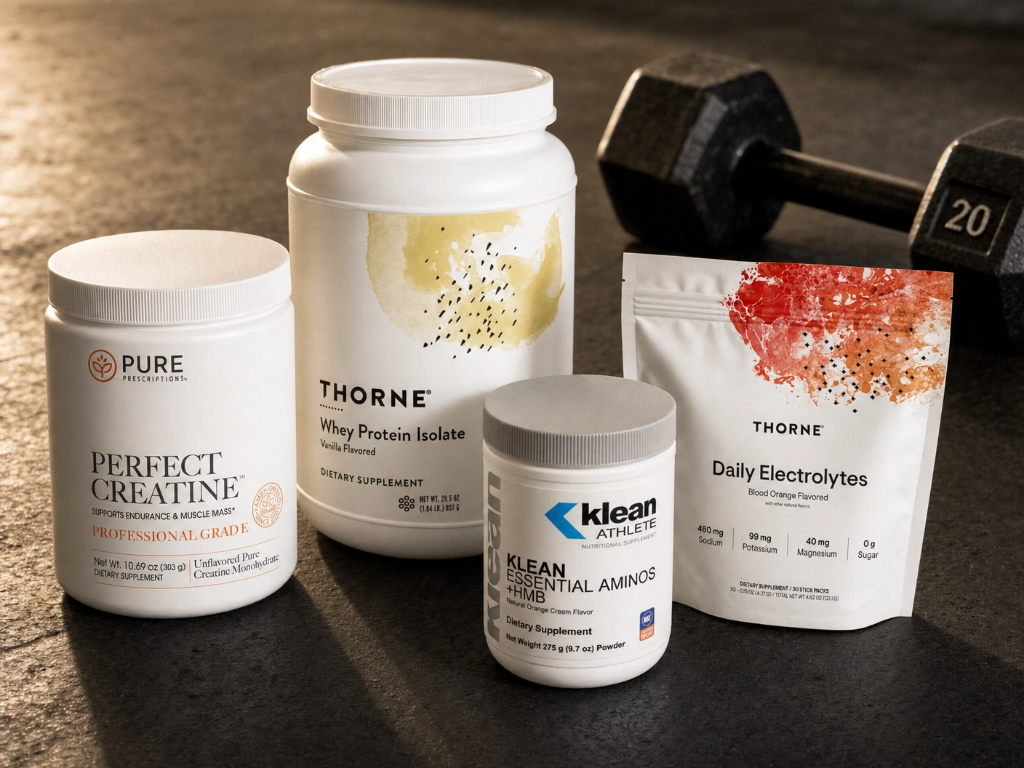
One scoop post-workout or whenever I haven’t eaten enough protein. Whey isolate is the most well-researched protein source in existence — rapidly absorbed, complete amino acid profile, documented muscle protein synthesis response. At 55, protein requirements for maintaining lean mass are higher than they were at 35, not lower. I’m not strategic about it. I just make sure I hit my number.
5 grams daily.
Every day. No cycling, no loading phase, just consistent daily intake in whatever I’m drinking at the time. The research on creatine at this stage of life is genuinely compelling — muscle preservation, cognitive function, reduced fatigue. It’s also the most researched performance compound in existence and costs almost nothing. I’ve been in this industry long enough to be skeptical of everything new and very confident about very few things. Creatine is one of them.
An all-arounder.
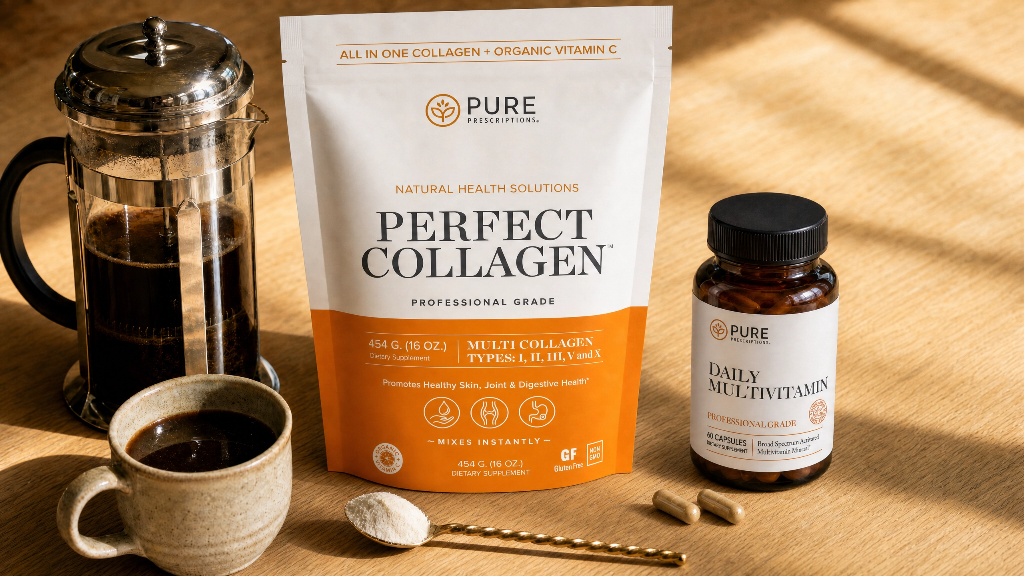
Activated B-vitamins, D3, a complete mineral panel. Not because I think I have significant deficiencies — because the gaps in even a reasonable diet are real and a well-formulated multi fills them efficiently. It’s not exciting. It’s not the thing I’d write an article about. It’s just correct.
That’s the protocol. No methylene blue. No peptide stacks. No continuous glucose monitor. Not because those things are necessarily wrong — some of them have interesting research — but because I’m not interested in chasing the next thing. I’ve watched too many ingredients arrive with extraordinary promise and leave with a footnote. The compounds I’m taking have decades of evidence behind them. That matters more to me than novelty.
“I’ve watched hundreds of trends move through this industry. The ones that are still here 20 years later tend to be the boring ones. That’s not a coincidence.”
What I Would Actually Recommend
If you’ve read this far expecting a purchase recommendation, here it is — though it’s probably not what you were anticipating.
Find something truly analog. Not pseudo-analog, not mostly-analog, but something that actually requires your full attention and makes technology either impossible or irrelevant. For me that’s the ocean. For you it might be something different. Rock climbing. Sailing. A garden you tend with your hands. A chess game with a person sitting across from you. Something that doesn’t allow you to be half-present.
Put on a record. Sit in the room with it. Don’t do anything else while it plays.
Take the unsexy supplements. The whey protein, the creatine, the multivitamin. Ignore whatever compound is currently trending. The research doesn’t care about trends, and neither, after 25 years, do I.
And recognize that some of the most important things you do for your health don’t involve supplements at all. The ocean has been better for me than any compound I’ve ever formulated. I say that as someone who has spent a career formulating compounds — and I mean it completely.
References
- 1.Kreider RB et al. “International Society of Sports Nutrition position stand: safety and efficacy of creatine supplementation in exercise, sport, and medicine.” Journal of the International Society of Sports Nutrition, 2017.
- 2.Avgerinos KI et al. “Effects of creatine supplementation on cognitive function of healthy individuals: a systematic review and meta-analysis of randomized controlled trials.” Nutrients, 2018.