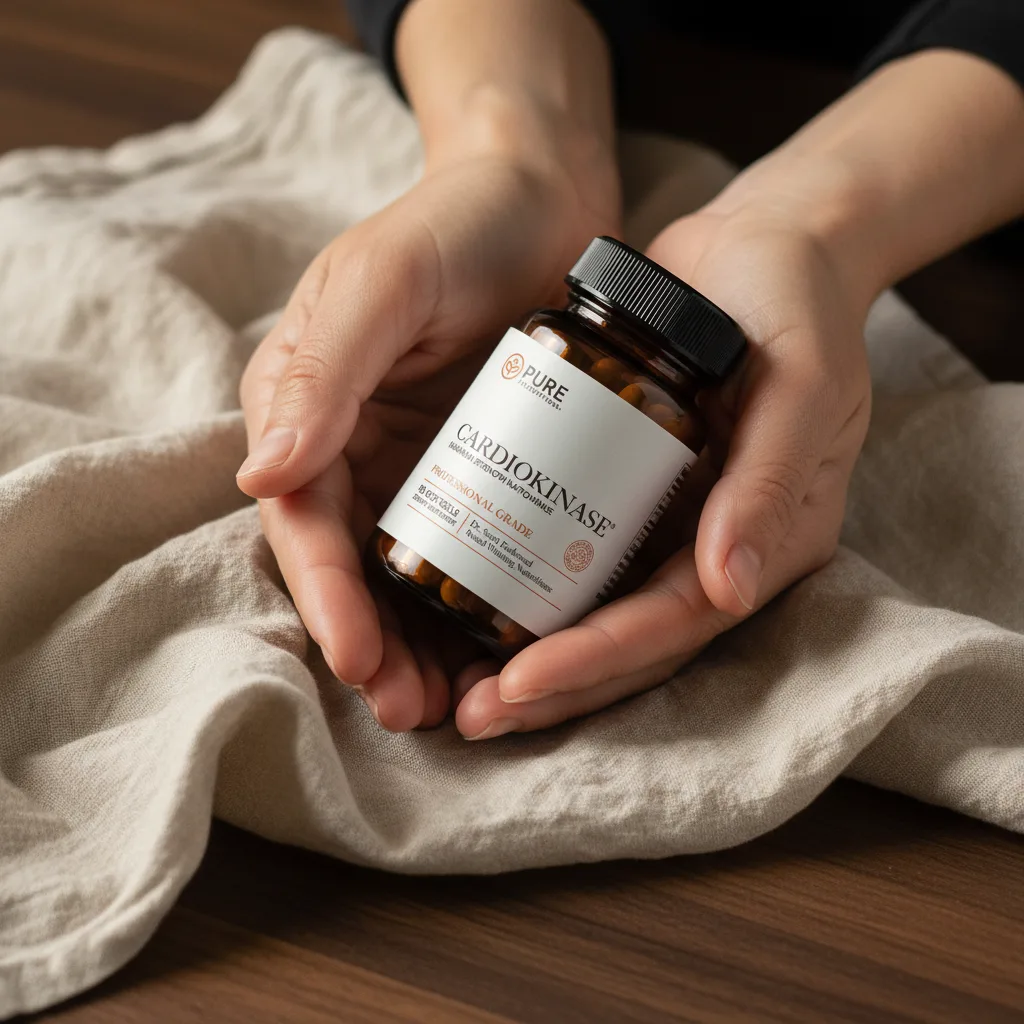

In 2001, I decided to take an enzyme I’d seen for years at trade shows and conferences — and occasionally in physicians’ offices and alternative pharmacies — and put it on a shelf where anyone could buy it. Nattokinase had never been sold direct to consumers in America before. We named ours Cardiokinase®. Twenty-five years later, I barely recognize the category we created.
I’m going to tell you what happened to nattokinase between then and now — because what happened is not a story about a good ingredient finally getting the attention it deserves. It’s a story about a good ingredient getting counterfeited at scale. By the mid-2010s, the shelves were full of products labeled “Nattokinase” that, when independently tested, contained no nattokinase at all. Many weren’t even derived from natto. Almost none had ever been near a clinical trial. And the vast majority were not produced by the Japanese fermentation process that gave the enzyme its name and its forty years of research.
I’m not going to name the brands — I’ll let the testing data do that work. But I am going to tell you exactly how to separate the real thing from the fakes, and I’m going to put the two strains I actually trust — including the one Dr. Hiroyuki Sumi, the enzyme’s discoverer, endorses exclusively — at the front of this conversation.
The Enzyme Dr. Sumi Found in 1980
The story starts with Dr. Hiroyuki Sumi, a Japanese biochemist who was studying fibrinolytic enzymes — compounds capable of dissolving fibrin, the protein that forms the mesh of a blood clot. In 1980, working at the University of Chicago, he dropped a small piece of natto, the traditional Japanese fermented soybean food, onto a fibrin plate in a petri dish. Within eighteen hours the fibrin had dissolved in a perfect circle around the natto. He’d found an enzyme with remarkable clot-dissolving activity. He named it nattokinase.1
Nattokinase is produced by Bacillus subtilis var. natto — the specific subspecies used to ferment traditional natto for centuries in Japan. It is a serine protease that cleaves fibrin directly, activates the body’s own tissue plasminogen activator (tPA), and inhibits PAI-1, the compound that blocks fibrinolysis. It also appears to inhibit ACE, the same enzyme targeted by a major class of blood pressure medications2. Four decades of research — more than seventeen human clinical trials — sit behind it3. That is the enzyme. That is what the word “nattokinase” is supposed to mean.
What We Did in 2001
For two decades before 2001, if you wanted nattokinase in this country, you mostly needed a doctor willing to stock it. As a practitioner, I’d seen it in physicians’ offices and alternative pharmacies — but mainly at trade shows and conferences, where professional-grade nutrition products surfaced long before they reached the consumer. Pure Prescriptions changed that. We were the first company in the United States to bring a professional-grade nattokinase direct to consumers — because I believed professional-grade nutrition shouldn’t require a referral.
By 2002 we’d put it under our own label and named it Cardiokinase®, formulated with a patented strain developed by Dr. Sumi himself, manufactured in Japan and imported directly. In 2008, Dr. Sumi developed an even more potent strain — HTNK-J® — and brought it to us exclusively. The following year, the Nutrition Business Journal recognized Cardiokinase® with a Product Merit Award. That’s the origin. Now here’s what happened to the category we opened up.
What Happened by the Mid-2010s
Through the 2010s, nattokinase started getting real attention outside Japan — first in Taiwan, then across the US supplement market. Demand outran supply almost overnight. And the supply that rushed in to meet that demand was, in many cases, not the supply that had built the research.
Here is the problem in plain terms. Real nattokinase comes from a specific fermentation: soybeans cultured with Bacillus subtilis var. natto — the strain used to make traditional Japanese natto for centuries. It is not a generic enzyme you can crank out of any bacterium. But as the category grew, manufacturers began producing “nattokinase” from other Bacillus subtilis strains and from entirely different fermentation substrates, then selling the resulting enzyme under the same name. The molecule is different. The activity is different. The safety profile is different. And the clinical research — all of which was conducted on authentic nattokinase from Bacillus subtilis var. natto — does not apply to it.
Inflated potency claims.
The standard unit of nattokinase potency is the Fibrinolytic Unit (FU), and the JNKA sets a standard daily dose of 2,000 FU. Independent testing has repeatedly found products whose label FU is far higher than the enzyme’s actual activity — and some whose “nattokinase” produces no authentic nattokinase degradation pattern at all.
Tested and found empty.
Using ELISA antibody testing, JNKA compared raw materials sourced from Japan, Taiwan, and the United States. The Japanese materials contained nattokinase in line with their stated FU. The US and Taiwanese materials contained no nattokinase whatsoever — they were different enzymes sold under the name.5
A different molecule entirely.
Genuine nattokinase is a protease that specifically degrades fibrin — the protein in blood clots — and its safety has been confirmed over decades of use. The substitute enzymes break down other proteins too, including ones your body needs. The safety of these substitutes has not been established.
“When they tested the raw material coming out of the US, it didn’t just have less nattokinase. It had none. Different enzyme, same label.”
No Clinical Studies Behind Them
This is the part the marketing copy never mentions. The human trials — the blood pressure reductions, the fibrinogen lowering, the carotid plaque regression data that made nattokinase famous — were all conducted on authentic nattokinase standardized to a verified FU value. If your “nattokinase” was fermented from a different bacterium on a different substrate and shows a different degradation pattern under HPLC, those studies do not describe what is in your bottle. You are taking an untested enzyme and borrowing the credibility of a tested one.
That’s not a reformulation. That’s a bait and switch. And it’s the reason a category I helped build now has a trust problem it didn’t have to have.
The Two Strains I Actually Trust
After twenty-five years, there are exactly two nattokinase raw materials I will put my name behind. Both are legitimate. Both are real nattokinase from authentic Bacillus subtilis var. natto fermentation. They are not the same, and the difference matters.
The original research strain.
Manufactured by Japan Biosciences and standardized to a verified FU value, this is the strain that anchors most of the published human research. We carry it. It is legitimate, third-party tested, and K2-free. If you buy nattokinase and the bottle names NSK-SD®, you are getting the real thing.6
The discoverer’s next-generation strain.
Developed by Dr. Hiroyuki Sumi himself — the enzyme’s original discoverer — in collaboration with Pure Prescriptions. Higher fibrinolytic activity per milligram than NSK-SD®, manufactured in Kurashiki, Japan, and the only nattokinase Dr. Sumi endorses. It is exclusive to Cardiokinase®.7
“There are two real nattokinases on the market. One built the research. The other was built by the man who discovered the enzyme. Everything else is a label.”
How to Tell the Real From the Fake
You don’t need a chemistry lab to protect yourself. You need to know what to look for on a label — and what to walk away from.
Look for the strain name. “Nattokinase” alone on a label, with no strain specified, is a red flag. Legitimate products name the strain — NSK-SD® or HTNK-J®. If a manufacturer has a real strain, they want you to know which one.
Look for the FU value, not just milligrams. The JNKA standard daily dose is 2,000 FU4. A bottle that lists only milligrams with no FU specification tells you nothing about potency. Two products can both claim 100mg and have a tenfold difference in actual fibrinolytic activity.
Look for proof of origin — a disclosed Japanese manufacturer, JNKA membership, or the JNKA mark. Look for third-party testing and a Certificate of Analysis you can actually request. And if the price looks too good to be true, it is. Authentic nattokinase cannot be fermented, shipped from Japan, third-party tested, and sold at the bottom of the price range. The cheap bottles are cheap because the enzyme inside them isn’t the enzyme on the label.
Why This Matters More Right Now
Nattokinase’s popularity spiked hard in 2022 and 2023 — driven by cardiovascular interest and a broader conversation about circulatory health. When demand spikes that fast, counterfeits rush in to fill the gap. The exact same thing happened in Taiwan in 2010, when the JNKA held a public press conference to promote the eradication of counterfeit nattokinase products. The pattern is repeating now in the US, and most consumers have no idea it’s happening.
If you’re taking nattokinase for your cardiovascular health, you deserve to know whether you’re actually taking nattokinase. The category we opened in 2001 has become one of the most counterfeited in the supplement aisle. The way to not get fooled is to buy from the people who were there at the beginning — or, at minimum, from a strain that has been tested and named. Cardiokinase® with HTNK-J® is the one I trust with my name on it. NSK-SD® is the one I trust with Dr. Sumi’s research behind it. Almost everything else on the shelf is a guess.
If I Had to Pick One
Cardiokinase®
HTNK-J® Nattokinase · 2,500 FU · Endorsed by Dr. Sumi
“If you’re going to take nattokinase, take the one the man who discovered the enzyme endorses. Cardiokinase® uses HTNK-J® — the strain Dr. Sumi developed and brought to us exclusively — at 2,500 FU per softgel, manufactured in Japan, third-party verified, and vitamin K2-free. NSK-SD® is an excellent, legitimate alternative if you want the original research strain. But if I had to pick one bottle to put in my own hand, this is it.”
We were there at the beginning of this category. Twenty-five years later, we’re still one of the only companies that can tell you — down to the strain, the facility, and the discoverer’s endorsement — exactly what’s in the bottle. That’s the standard nattokinase should be held to. Hold the bottle in your hand to that standard, and most of the aisle disappears.
References
- 1.Sumi H. — discovery of nattokinase at the University of Chicago (1980). Reviewed in Weng Y. et al., “Nattokinase: An Oral Antithrombotic Agent for the Prevention of Cardiovascular Diseases” (Int. J. Mol. Sci., 2017).
- 2.Nattokinase mechanisms — direct fibrinolysis, tPA activation, PAI-1 and ACE inhibition. Weng Y. et al. (Int. J. Mol. Sci., 2017).
- 3.Li X. et al. “Nattokinase Supplementation and Cardiovascular Risk Factors” — systematic review and meta-analysis of randomized controlled trials (2023).
- 4.Japan NattoKinase Association (JNKA) — standard daily dosage of 2,000 FU and counterfeit-nattokinase warning.
- 5.JNKA — ELISA antibody testing of raw nattokinase materials sourced from Japan, Taiwan, and the United States (counterfeit findings).
- 6.NSK-SD® — nattokinase fermented from JBSL’s patented Bacillus subtilis natto strain; Vitamin K2 removal patented by Japan Bio Science Laboratories (JBSL).
- 7.Cardiokinase® — the only nattokinase brand endorsed by Dr. Hiroyuki Sumi; formulated with the HTNK-J® strain. Pure Prescriptions product page.